The Atlantic Area Community of Practice – AA CoP
Across the Atlantic Area, a wide range of projects, initiatives and policy frameworks contribute to addressing key environmental and blue economy challenges. These efforts generate valuable knowledge, tools and solutions, yet their integration into policy processes remains uneven across sectors and governance levels.
The AA CoP has been established within the GRAAL project to address this gap. It provides a structured space for dialogue and collaboration, supporting the interpretation, alignment and uptake of project results in relation to EU and Atlantic policy priorities.
The AA CoP focuses on connecting existing knowledge with decision-making processes, fostering coordination, mutual learning and policy-relevant exchange. It operates through a CoP, bringing together policy-makers, managing authorities, researchers, industry and civil society to foster collaboration, knowledge exchange and policy-oriented dialogue across the Atlantic Area.
Thematic focus
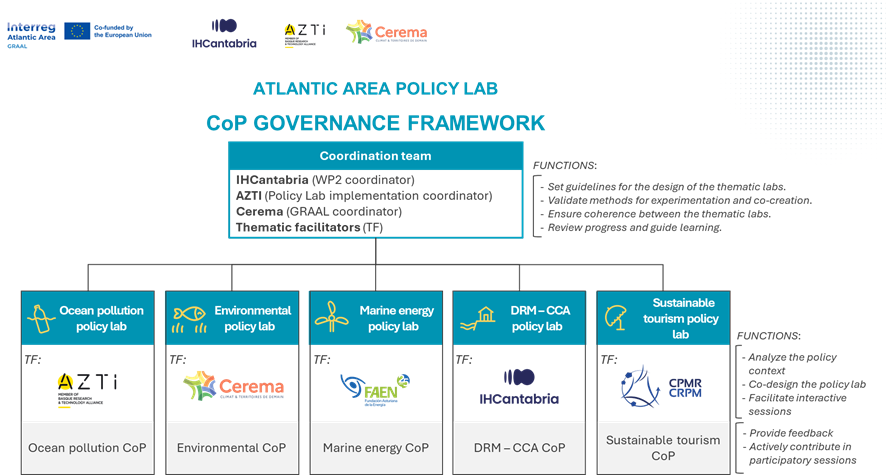
The Policy Lab is structured around five thematic areas:
Marine energy
Marine energy in the Atlantic Area is characterised by challenges related to security of energy supply, development of regional value chains, lack of regulation supporting new marine renewable energy projects, and the need for large infrastructures (e.g. ports) to manufacture and assemble components. Additional issues include the development of smart grid connections and the social acceptance of both projects and the use of maritime space.
Ocean pollution
Ocean pollution in the Atlantic Area is characterised by challenges related to the need for harmonised methods for monitoring and assessment (e.g. sensors and environmental quality standards), identification of pollutants and pollution hotspots, and assessment of pollution effects. Additional aspects include the development of nature-based solutions, improvement of wastewater treatment, establishment of monitoring systems and indicators, as well as governance fragmentation, lack of stakeholder engagement, and the need to apply successful practices across the Atlantic.
Disaster Resilient Coasts
This thematic area is aligned with Goal 6, “Stronger Coastal Resilience,” under Pillar IV of the Atlantic Area, “Healthy Oceans and Resilient Coasts,” as well as with other relevant European and international initiatives related to climate change adaptation and disaster risk management. It promotes an integrated disaster risk management approach, addressing both climate-related and non-climate hazards from a multi-hazard perspective.
Erosion and coastal flooding are among the key challenges facing coastal areas. In this context, adaptation, preparedness, and prevention measures are essential, together with the capacity to anticipate and respond effectively to risk-related crises.
To achieve this, scientific and technical advances need to be effectively translated into practice through knowledge transfer mechanisms. At the same time, strengthened governance and the development of shared knowledge bases are crucial to support informed decision-making. In this regard, the thematic area aims to connect policy, science, and practice, fostering collaboration across stakeholders.
Finally, adequate resources are a cornerstone of this approach. Ensuring effective funding mechanisms for coastal resilience is therefore a key component of this thematic area.
Nature preservation
Nature preservation in the Atlantic Area is characterised by challenges related to achieving MPA targets for 2030 (including Natura 2000), recovery of good environmental status, and implementation of nature-related regulations. Additional aspects include ensuring the sustainability of blue economy sectors and addressing governance, finance, monitoring, and public and citizen awareness.
Sustainable tourism
Sustainable tourism in the Atlantic Area is characterised by challenges related to improving working conditions and skills in the tourism sector, reducing seasonality through better distribution of tourism flows, and monitoring environmental pressures (e.g. water use in tourism areas). Additional aspects include improving coordination of energy and water management and harmonising regulations for rental accommodation platforms.
It also integrates three cross-cutting priorities:
Digitisation and innovation
o Digitisation and innovation are linked to the development of tourism experiences and to the establishment of monitoring systems and indicators across thematic areas.
Circular economy
Circular economy is linked to waste reduction, recycling practices, and pollution reduction, particularly in relation to marine litter.
Governance
Governance is characterised by challenges related to fragmentation, lack of coordination across levels, unclear roles and responsibilities, and the need for stronger stakeholder involvement and dissemination of results.
Governance of the AA CoP
The AA CoP operates through a flexible and collaborative structure designed to support coordination while remaining open and adaptive.
- Coordination team
A core facilitation team ensures overall coherence and alignment with GRAAL objectives - Thematic facilitators
Project partners support the organisation of discussions across thematic areas - Community members
Stakeholders from across the Atlantic Area contribute to the CoP through active participation - Policy actors
Managing Authorities and public institutions ensure policy relevance and uptake
The AA CoP functions as a facilitation mechanism rather than a formal governance body, supporting interaction and coordination across sectors and territories.
Members of the AA CoP
The AA CoP brings together stakeholders from across the Atlantic Area, including:
- Public authorities
- Research and academic institutions
- Private sector actors
- Civil society organisations
- Project partners and associated stakeholders
This diversity reflects the complexity of environmental governance and supports inclusive, evidence-based dialogue processes.