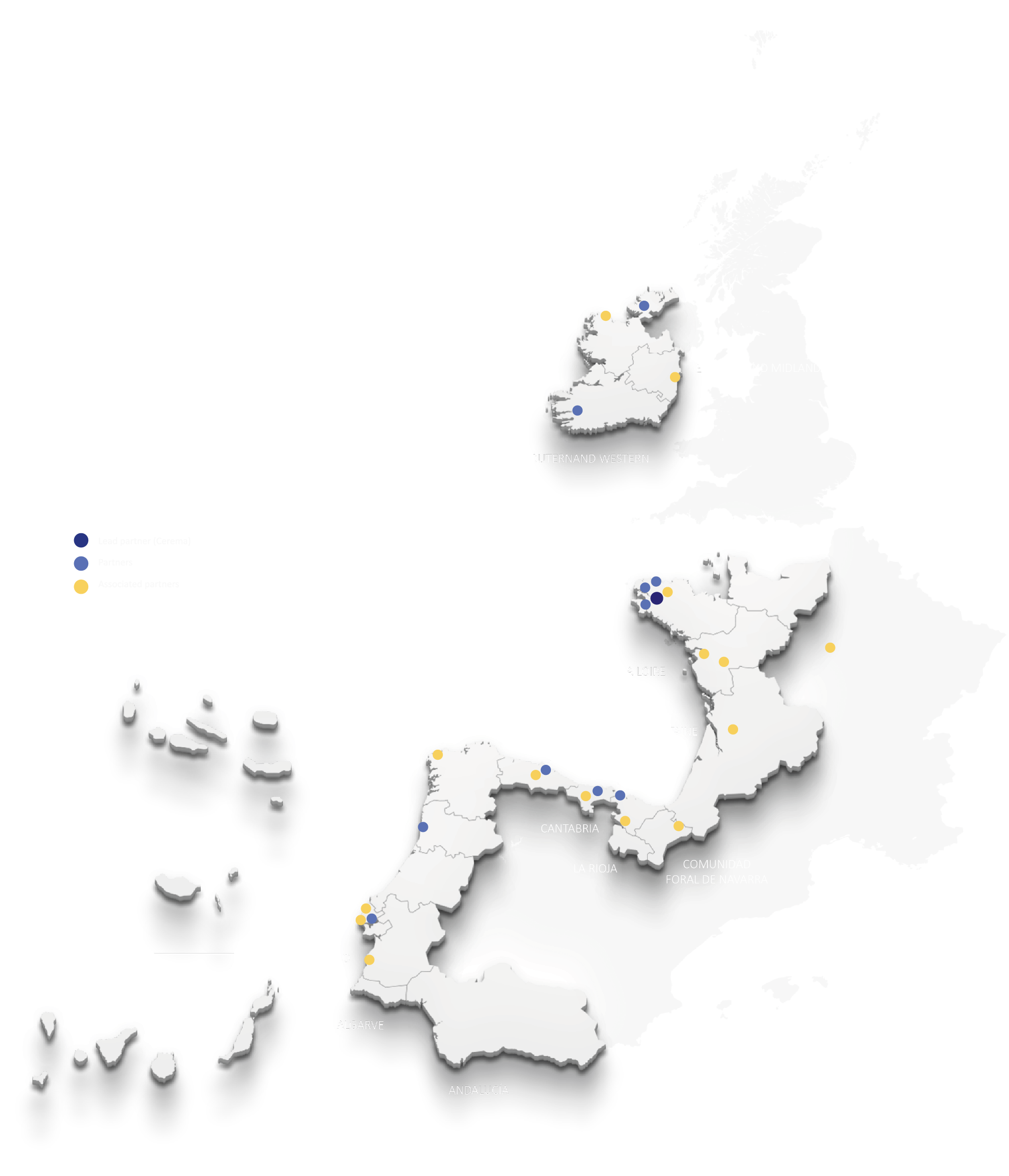
GRAAL project partners
11 partners from France, Ireland, Spain and Portugal & 15 associated partners to date, mainly public authorities at national, regional and local level
Lead partner
Cerema (France)
Partners
IHCantabria – Instituto de Hidráulica Ambiental de la Universidad de Cantabria (Espagne)
Forum Oceano (Portugal)
CPMR – Conférence des Régions Périphériques Maritimes (France)
PMBA – Pôle Mer Bretagne Atlantique (France)
ERNACT – European Regions Network for the Application of Communications Technology (Irlande)
AZTI (Espagne)
CCDR LVT – Comissão de Coordenação e Desenvolvimento Regional de Lisboa e Vale do Tejo (Portugal) Atlantic Cities (France)
RDI Hub (Southern, Ireland) FAEN – Fundación Asturiana de la Energí (espagne)
🇫🇷 Cerema (France)
website: https://www.cerema.fr
Cerema is a French public institution with expertise in spatial planning, environment, climate and ecological transition. Within GRAAL, it notably leads methodological work, project evaluation and recommendations for European policies. It plays a central role in structuring capitalisation activities and in the project’s scientific coordination.
🇪🇸 IHCantabria – Instituto de Hidráulica Ambiental de la Universidad de Cantabria (Espagne)
website: https://fundacionih.es
IHCantabria is a research centre specialised in coastal engineering, natural hazards and environmental management. It leads the set-up and facilitation of the Atlantic Policy Lab within the project. Its expertise strengthens the link between scientific results and environmental public policies.
🇵🇹 Forum Oceano (Portugal)
website: https://forumoceano.pt
Forum Oceano is the Portuguese blue economy cluster, bringing together companies, research centres and public actors. Within GRAAL, it coordinates the development of transnational roadmaps with stakeholders. It contributes to the emergence of structuring projects at Atlantic scale.
🇪🇺 CPMR – Conférence des Régions Périphériques Maritimes (Europe)
website: https://cpmr.org

CPMR is a European network representing more than 150 maritime regions. It leads work on transnational action plans and on the alignment of European funding. Its role is strategic in strengthening coordination between regional and European policies.
🇫🇷 PMBA – Pôle Mer Bretagne Atlantique (France)
Pôle Mer Bretagne Atlantique is a competitiveness cluster dedicated to maritime innovation. It contributes to the inventory of existing projects and to work on energy transition and circular economy within the blue economy. It provides strong connections to the industrial and innovation ecosystem.
🇮🇪 ERNACT – European Regions Network for the Application of Communications Technology (Irlande)
website: https://www.ernact.eu
ERNACT is a European network specialised in digitalisation and territorial innovation. It contributes to the analysis of cross-cutting contributions and to themes related to digital transformation. It supports the integration of digital solutions into Atlantic policies and projects.
🇪🇸 AZTI (Espagne)
website: https://www.azti.es
AZTI is a technology centre with expertise in marine environment, fisheries and a sustainable blue economy. It contributes to the evaluation of project results in relation to environmental policies. Its expertise notably covers ocean pollution and the sustainability of marine ecosystems.
🇵🇹 CCDR LVT – Comissão de Coordenação e Desenvolvimento Regional de Lisboa e Vale do Tejo (Portugal)
website: https://www.ccdr-lvt.pt
CCDR LVT is a Portuguese regional authority responsible for coordinating regional development. It leads the development of the strategic document aimed at integrating project results into regional, national and European policies. It ensures the link between capitalisation and public programming.
🇫🇷 🇪🇺 Atlantic Cities (France – réseau européen)
website: https://atlanticcities.eu
Atlantic Cities is a network of cities along the Atlantic seaboard engaged in European cooperation. It contributes to proposals to improve the Atlantic Area Programme. Its role is to bring the perspective of local authorities into the project’s governance.
🇮🇪 RDI Hub (Irlande)
website: https://rdihub.com

RDI Hub is an organisation supporting innovation and entrepreneurship. It contributes to links with project incubators and supports the maturation of initiatives emerging from transnational roadmaps. It strengthens the transition from strategy to operations.
🇪🇸 FAEN – Fundación Asturiana de la Energía (Espagne)
website: https://faen.es
FAEN is a foundation specialised in energy and the energy transition. It notably contributes to work on marine renewable energies and energy efficiency in the blue economy. Its expertise complements the consortium’s technical and sectoral approach on energy-related themes.
Public authorities at the heart of strategic orientations
GRAAL brings together scientific and thematic experts with public authorities at all levels—groups of municipalities, metropolitan areas, regions and specialised public bodies. Their involvement reflects the diversity of decision-making and action scales, and helps anchor the work in the concrete realities of Atlantic territories.
These public partners share their experience in implementing territorial policies, lessons learned from projects deployed on the ground, and priorities identified in close contact with local stakeholders. Their contributions feed the project’s strategic exchanges and help shape recommendations developed at Atlantic scale.
The proposals developed within GRAAL therefore build both on the analysis of project results and on feedback from local authorities and competent bodies. This articulation ensures that the orientations put forward take into account local dynamics, institutional frameworks and territories’ capacity to act.
Becoming an associated partner in GRAAL means actively contributing to this collective dynamic: showcasing your territory’s experience, sharing your priorities and participating in the development of recommendations grounded in institutional expertise and public action at all scales.
They have joined the initiative:
- Office Français de la Biodiversité (Ile-de-France, France)
- Gobierno de Navarra (Navarra, Spain)
- Comissão de Coordenação e Desenvolvimento Regional do Alentejo, IP (Alentejo, Portugal)
- Brest Metropole (Bretagne, France)
- Regional Council of Pays de la Loire (Pays de la Loire, France)
- Donegal County Council (Northern and Western, Ireland)
- Ayuntamiento de Santander (Cantabria, Spain)
- Dirección General de Fondos Europeos. Consejería de Economía, Hacienda y Fondos Europeos. Gobierno de Cantabria (Cantabria, Spain)
- Área Metropolitana de Lisboa (Grande Lisboa, Portugal)
- Communauté d'Agglomération de La Rochelle (Nouvelle Aquitaine, France)
- Direction générale des affaires maritimes, de la pêche et de l'aquaculture (Ile-de-France, France)
- Turismo de Portugal, I.P. (Grande Lisboa, Portugal)
- Ayuntamiento de A Coruña (Galicia, Spain)
- Gobierno Vasco (País Vasco, Spain)
- Gobierno del Principado de Asturias (Principado de Asturias, Spain)
- BIM Ireland's Seafood Development Agency (Eastern and Midland, Ireland)