GRAAL project
Strengthening governance and the impact of European policies in the Atlantic Area
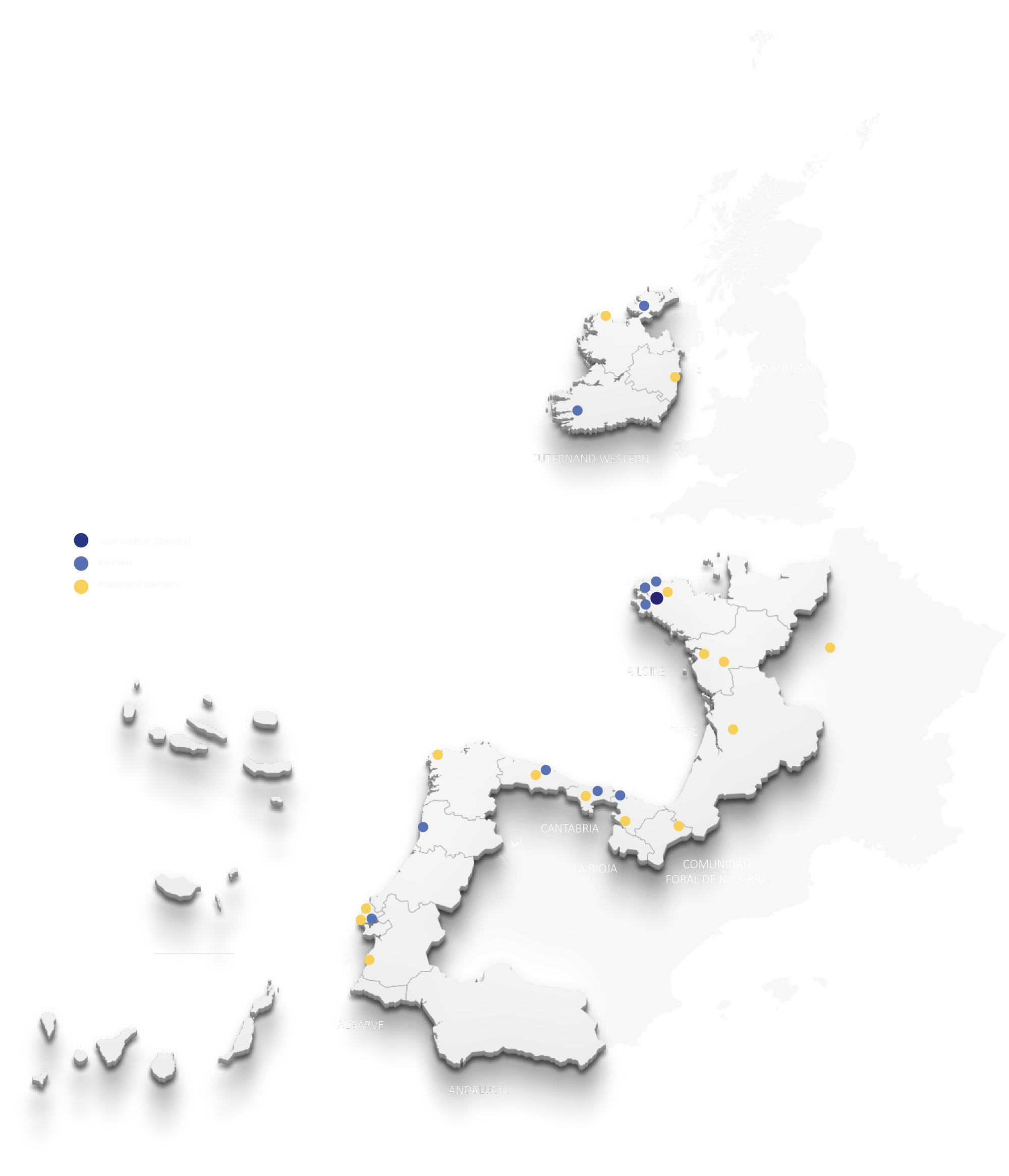
The Atlantic Area links four countries and 22 regions around a shared maritime and coastal space. This territory—rich in environmental and economic diversity—faces major and common challenges: climate-change adaptation, integrated coastal zone management, biodiversity protection, energy transition, and safeguarding the quality of marine environments.
To address these issues, the European Union has structured its action through ambitious strategic frameworks—the Atlantic Maritime Strategy, the European Green Deal, and the development of a sustainable blue economy—and through cooperation programmes that support innovation and collaboration between territories.
Over the years, many projects have been funded in the Atlantic Area. They have generated knowledge, developed operational tools, structured environmental databases and strengthened partnerships between public authorities, scientific actors and the business sector. These initiatives now form a solid foundation that must be valorised, analysed and better connected with public policies.
Funded by the Interreg Atlantic Area Programme, GRAAL is part of this dynamic. The project aims to improve the governance of cooperation programmes, strengthen coordination and synchronisation of funding, and formulate recommendations to inform the evolution of European policies.
By structuring the analysis of existing projects, fostering dialogue between actors and developing concrete proposals for the future, GRAAL helps consolidate transnational cooperation in support of a sustainable and coherent development of the Atlantic Area.
.
Strand 1
Structuring knowledge and capitalising on existing results
The first strand is dedicated to systematising and analysing existing projects in the Atlantic Area.
It begins with the development of a shared methodology to assess project results. This methodology makes it possible to analyse deliverables, produced data, developed tools and their potential for future use in a consistent way. An in-depth desk review and inventory then builds a structured database of relevant projects, beyond Interreg alone. This step produces a meaningful mapping of initiatives, programmes, networks and entities linked to Atlantic environmental challenges.
Thematic project analysis then assesses:
- effective capitalisation of results,
- dissemination,
- availability and accessibility of data.
This approach also checks whether data are integrated into relevant European, national and regional portals, and encourages their valorisation in appropriate repositories. Finally, a specific analysis of contributions to cross-cutting themes complements this work, linking sectoral results with challenges related to digitalisation, circular economy and governance.
This first strand is the foundation of the whole project: it transforms an accumulation of projects into shared strategic knowledge.
#1
precondition
The first strand is dedicated to systematising and analysing existing projects in the Atlantic Area.
Strand 2
Bringing project results and public policies into dialogue
The second strand strengthens networks and governance through the establishment of an Atlantic Area Environment Policy Lab.
This structured mechanism supports analysis of project results in light of environmental challenges and their connection with public policies, contributing to the overall objective of improving programme governance.
It includes assessing results in direct relation to environmental policy issues, organising matchmaking meetings between actors, and producing a strategic document on integrating achievements into regional, national and European policies.
The community of practice is supported by a long-term platform ensuring continuity beyond the project’s duration.
#2
Dialogue
The second strand strengthens networks and governance through the establishment of an Atlantic Area Environment Policy Lab.
Strand 3
Building roadmaps and structuring initiatives
A third strand supports the development of transnational roadmaps with stakeholders and joint action plans between public authorities.
This work helps identify shared priorities, structure long-lasting cooperation and bring forward high-impact initiatives at Atlantic scale. The identification of lead organisations ensures continuity of actions beyond the project.
#3
Action
Support the development of transnational roadmaps with stakeholders and joint action plans between public authorities.
Strand 4
Contributing to better alignment of funding and European policies
Finally, the last strand develops a methodology to explore synchronised calls—particularly within the ERDF framework—and formulates proposals for improvement for the Atlantic Area Programme and for future European policy developments.
In doing so, GRAAL contributes to wider European reflections, notably in connection with the Atlantic Maritime Strategy and European Commission initiatives.
#4
Funding
Develop a methodology for considering synchronised calls and formulate proposals for improvement for the Atlantic Area Programme.